

We are a digital agency helping businesses develop immersive, engaging, and user-focused web, app, and software solutions.
2310 Mira Vista Ave
Montrose, CA 91020

2500+ reviews based on client feedback
What's Included?
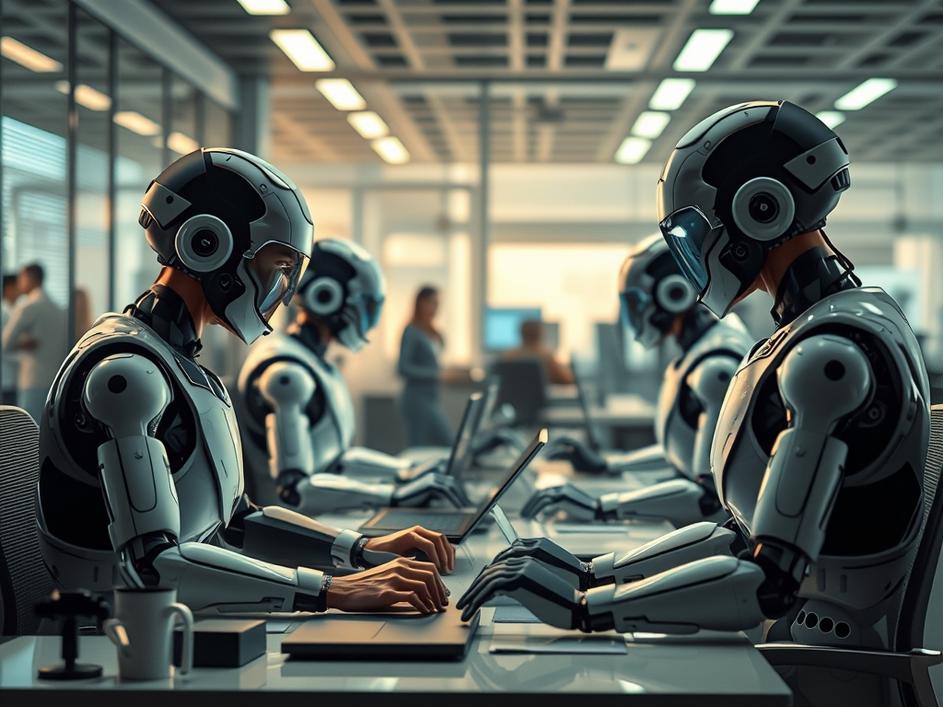
ToggleFor years, we’ve heard whispers about robots taking our jobs. Now, those whispers are turning into a roar as artificial intelligence gets smarter and more capable. It’s no longer a far-off science fiction scenario; it’s happening right now. Several major companies are openly talking about replacing human employees with AI, and it’s causing both excitement and anxiety.
HP, for example, has announced plans to cut thousands of jobs in the next few years, explicitly citing AI-driven productivity as a key factor. IBM, another tech giant, is also making similar moves, re-evaluating its workforce in light of AI advancements. These aren’t isolated cases. Other companies across various sectors are exploring how AI can automate tasks previously handled by humans. While the exact number of jobs impacted remains to be seen, the trend is undeniable. AI is poised to reshape the labor market in profound ways.
It’s easy to get caught up in the fear of widespread job losses. However, the reality is more nuanced. While some jobs will undoubtedly be eliminated, AI also has the potential to create new opportunities. The focus should shift toward adapting to this changing landscape. What new skills will be needed to work alongside AI? How can we ensure that the benefits of AI are shared broadly, rather than concentrated in the hands of a few? These are the crucial questions we need to be asking.
Companies are realizing that AI can handle repetitive tasks faster and more accurately than humans. This frees up human employees to focus on more creative, strategic, and interpersonal work. Think about it: instead of spending hours crunching numbers, an employee could analyze the data and develop new insights. Instead of answering the same customer service questions over and over, they could focus on resolving complex issues that require empathy and critical thinking.
The key to navigating this transition is upskilling. Workers need to acquire the skills that are in demand in the age of AI. This includes things like data analysis, programming, AI development, and other tech-related skills. But it also includes uniquely human skills like critical thinking, problem-solving, communication, and creativity. These are the skills that AI can’t easily replicate, and they will be essential for thriving in the future of work. Furthermore, businesses must invest in training their employees to use AI tools effectively. This ensures a smooth transition and allows employees to leverage AI to enhance their performance.
As AI takes on a larger role in the workplace, we also need to address the ethical considerations. Bias in AI algorithms can lead to unfair or discriminatory outcomes. It’s important to ensure that AI systems are developed and used in a responsible and ethical manner. Transparency and accountability are crucial. We need to understand how AI systems are making decisions and hold them accountable for their actions. There must also be safeguards in place to prevent AI from being used to exploit or harm workers.
Another key ethical consideration is the potential for increased inequality. If the benefits of AI are concentrated in the hands of a few, it could exacerbate existing inequalities. Policies are needed to ensure that the benefits of AI are shared more broadly. This could include things like universal basic income or other forms of social support. The goal should be to create a society where everyone can benefit from the advancements in AI.
Rather than viewing AI as a job-destroying force, it’s more accurate to think of it as a tool that can augment human capabilities. When humans and AI work together, they can achieve more than either could alone. AI can handle the mundane, repetitive tasks, freeing up humans to focus on the things they do best. This can lead to increased productivity, innovation, and job satisfaction. The future of work is not about humans versus AI; it’s about humans *with* AI.
The shift towards AI in the workplace is inevitable. The best approach is to embrace this change and proactively shape the future of work. This requires a collaborative effort between businesses, governments, and individuals. Businesses need to invest in training and development to prepare their employees for the AI-powered workplace. Governments need to create policies that support workers and ensure that the benefits of AI are shared broadly. And individuals need to take responsibility for their own learning and development, acquiring the skills that will be in demand in the future.
The rise of AI presents both challenges and opportunities. By addressing the ethical considerations, investing in upskilling, and embracing the concept of the AI-augmented workforce, we can create a future where AI benefits everyone. It’s time to move beyond the fear and embrace the potential of AI to create a more prosperous and equitable future for all.



Comments are closed