

We are a digital agency helping businesses develop immersive, engaging, and user-focused web, app, and software solutions.
2310 Mira Vista Ave
Montrose, CA 91020

2500+ reviews based on client feedback
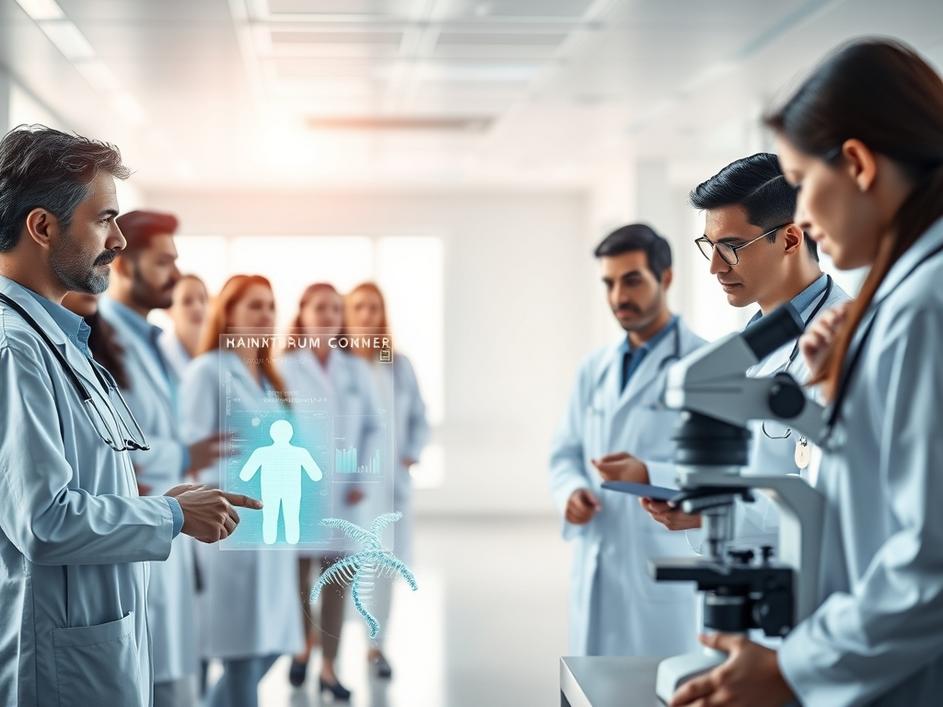
The way we think about health and medicine is changing, and it’s happening faster than ever. For a long time, healthcare moved slowly, building on years of research and practice. But now, new technologies are hitting the scene, making big waves. Things like advanced artificial intelligence, quantum computing, and breakthroughs in biotechnology are not just helping; they are completely rethinking how we prevent, find, and treat illnesses. Big gatherings, like GITEX GLOBAL, have become places where experts show off these amazing ideas, giving us a peek into a future that once felt like science fiction. We’re talking about a multi-trillion-dollar shift, and it means better care for more people.
Artificial intelligence, or AI, is already a big helper in healthcare. It’s not about robots replacing doctors, but about giving doctors powerful tools. AI can look at a patient’s health records, scan images like X-rays or MRIs, and even help find small problems that human eyes might miss. This means diseases can be caught earlier, often when they are easier to treat. Think about how much information a hospital gathers every day. AI can sort through all of that data in a snap, finding patterns and making predictions. For example, it can help figure out which treatment might work best for a specific person, based on their unique genes and health history. It also helps with the boring, repetitive tasks, freeing up doctors and nurses to spend more time with patients. So, AI helps make healthcare more personal and more effective, step by step.
Now, let’s talk about quantum computing. This technology is still pretty new and not something we see every day, but it holds amazing promise for medicine. Regular computers work with bits that are either 0 or 1. Quantum computers use “qubits” that can be both 0 and 1 at the same time, and they can be linked in complex ways. This lets them solve problems that are just too hard for even the most powerful normal computers. In healthcare, this means we could design new drugs much faster. Imagine simulating how a new medicine would interact with a human body at an atomic level. Quantum computers could do that. They could also help us understand very complex diseases, like Alzheimer’s or certain cancers, by crunching huge amounts of biological data. It’s like having a super brain that can see connections and possibilities that are currently hidden from us. This could really speed up how we find cures and make healthcare truly advanced.
Biotechnology is another huge area making a difference. This field focuses on using living things, or parts of them, to create new products or solve problems. One of the most exciting parts is gene editing, where scientists can make precise changes to a person’s DNA. This means we might be able to fix genetic diseases right at their source. Think about illnesses that run in families; biotech offers hope to stop them before they even start. We’re also seeing new ways to make vaccines and treatments tailored to a person’s own body. Cell therapies, where healthy cells are used to replace or repair damaged ones, are also growing. These breakthroughs are not just treating symptoms; they are going deep to correct the underlying issues. It’s about personalizing medicine in a way we’ve only dreamed of, literally changing the blueprint of life to improve health.
These amazing technologies – AI, quantum computing, and biotech – are not working alone. They are all connected, and that’s where the real power lies. AI can help scientists sort through massive amounts of data generated by biotech experiments. Quantum computers, when they become more common, could speed up the complex calculations needed for both AI models in medicine and for designing biotech solutions. For example, finding a new drug using biotech methods might involve looking at millions of different molecules. AI can help narrow down the best candidates, and quantum computing could run ultra-fast simulations of those candidates to see how they might work. This teamwork means we can tackle health challenges from many angles, making progress much quicker. It’s like having a big, smart team where each member brings a special skill, all working towards a common goal: better health for everyone.
While all this new tech offers so much hope, it also brings big questions. How do we make sure these advanced healthcare tools are available to everyone, not just those who can afford them? There are also important talks about privacy – who gets to see our health data, and how do we keep it safe? And what about the ethical side of things, especially with gene editing? We need to make sure we use these powerful tools wisely and responsibly. These are not small issues, and they require thoughtful discussions from governments, doctors, tech companies, and regular people. The goal is to build a future where technology serves humanity, making us healthier and happier, without leaving anyone behind. It’s a journey, and we’re just at the beginning, but the path looks exciting.
So, the world of healthcare is on the cusp of something truly great. The conversations and innovations highlighted at events like GITEX GLOBAL show us a path where sickness might be less scary, and treatments are more effective and personal. AI helps us understand disease better, quantum computing gives us unbelievable processing power, and biotech allows us to fix problems at a very basic level. It’s a journey that will take time and thought, balancing amazing new possibilities with the need for fairness and care. But one thing is clear: the future of health is not just about better medicine; it’s about a smarter, more connected, and more hopeful approach to well-being for all of us.



Comments are closed