

We are a digital agency helping businesses develop immersive, engaging, and user-focused web, app, and software solutions.
2310 Mira Vista Ave
Montrose, CA 91020

2500+ reviews based on client feedback
What's Included?
ToggleArtificial intelligence is no longer a futuristic fantasy; it’s rapidly becoming a core component of how businesses operate. We’re seeing AI integrated into various sectors, handling tasks from customer service to data analysis. But what happens when a company decides to build its entire operational structure around AI? That’s precisely what Bairong, a Chinese firm, is doing, and their approach is raising eyebrows and sparking conversations about the future of work.
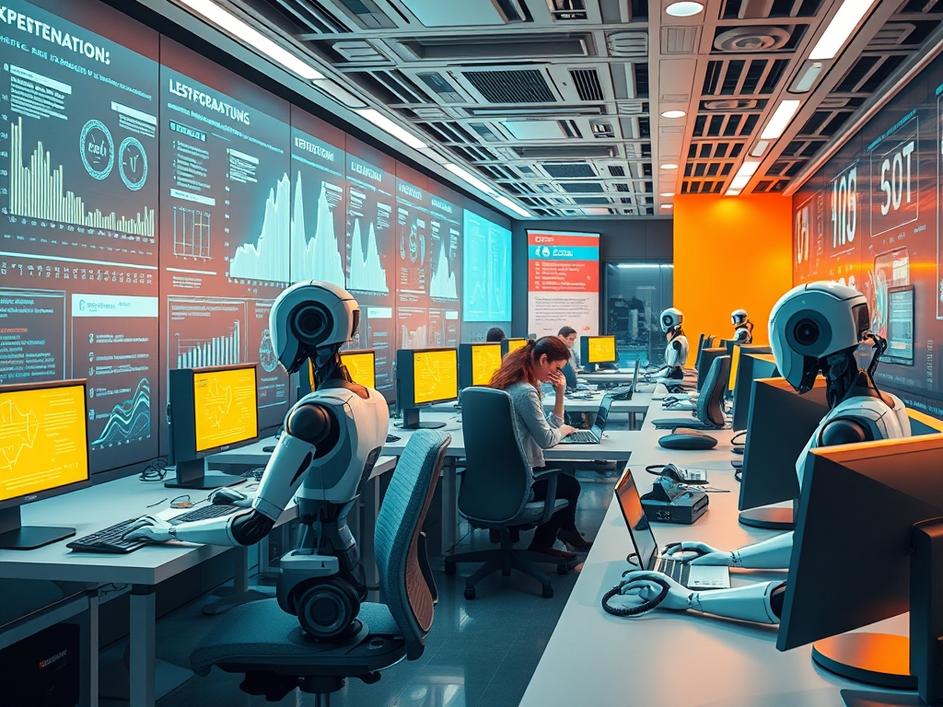
Bairong isn’t just experimenting with AI tools; they’re building an entire workforce powered by them. They claim to have deployed 200,000 “silicon-based employees” across various client organizations. These aren’t just chatbots answering simple questions; they’re sophisticated AI agents handling complex tasks. Think of it as outsourcing, but instead of human employees, you’re hiring a fleet of AI agents managed by Bairong. It’s a bold move that forces us to reconsider what a company looks like in the age of AI.
While the idea of 200,000 AI employees might sound abstract, Bairong is showcasing tangible applications. Their VoiceAgent, for example, likely automates customer service interactions, freeing up human agents to handle more complex issues. WiseNote probably offers AI-powered note-taking and knowledge management, potentially improving efficiency across various departments. The “Home for Silicon-Based Employees” concept suggests a centralized platform for managing and deploying these AI agents, indicating a comprehensive AI infrastructure.
The mention of Harvard in the press release hints at a collaboration that lends credibility to Bairong’s endeavor. It suggests that Bairong isn’t just throwing AI at problems; they’re approaching AI integration strategically, potentially leveraging academic research and expertise. Furthermore, the emphasis on “enterprise-grade practice” is crucial. Many companies offer AI features, but few have successfully integrated AI across their entire operations. Bairong seems to be positioning itself as a leader in holistic AI solutions.
Of course, the success of Bairong’s model hinges on several factors. Can these AI agents truly handle the complexities of various business tasks? How will human employees adapt to working alongside a massive AI workforce? What are the ethical considerations of replacing human workers with AI? These are critical questions that need to be addressed. The idea of silicon-based employees also brings up concerns about bias in AI algorithms, data security, and the potential for job displacement. While the concept is intriguing, its long-term impact remains to be seen.
One of the biggest questions this raises is the role of human employees in this AI-driven future. While AI can automate repetitive tasks and analyze data with incredible speed, it currently lacks the critical thinking, creativity, and emotional intelligence that humans bring to the table. Jobs may evolve, requiring workers to focus on tasks that require uniquely human skills, such as complex problem-solving, strategic thinking, and interpersonal communication. Training and upskilling the existing workforce will be crucial to ensure a smooth transition and avoid widespread job losses. The real challenge lies in finding the right balance between AI automation and human capabilities.
Bairong’s experiment offers a glimpse into a potential future where AI is deeply ingrained in every aspect of business. It’s a future where companies may be leaner, more efficient, and more data-driven. But it’s also a future that requires careful consideration of the ethical, social, and economic implications of widespread AI adoption. Bairong is not just building AI tools; they’re reshaping the very definition of work and the nature of organizations. Whether this bold bet pays off remains to be seen, but it’s certainly a development worth watching closely. The success of Bairong’s model hinges on several factors, including the adaptability of human workers, the robustness of the AI algorithms, and the ethical considerations that guide its deployment. As we move forward, it will be crucial to monitor the outcomes of this experiment and learn from both its successes and its failures.
Beyond the specific applications of VoiceAgent and WiseNote, Bairong’s approach could signal a fundamental shift in how organizations are structured. Instead of traditional hierarchies, we might see more fluid, AI-driven networks where tasks are dynamically assigned to the most suitable agent, human or silicon-based. This could lead to increased agility, faster decision-making, and greater efficiency. However, it also raises questions about accountability, transparency, and the potential for bias in algorithmic decision-making. As AI becomes more integrated into the workplace, it will be essential to develop clear ethical guidelines and regulatory frameworks to ensure responsible and equitable deployment.
Bairong’s ambitious project is a reminder that the AI revolution is not just about developing new technologies; it’s about fundamentally rethinking how we work, organize, and create value. As AI continues to advance, businesses must proactively address the challenges and opportunities it presents. This includes investing in training and upskilling programs for human employees, developing ethical guidelines for AI deployment, and fostering a culture of collaboration between humans and machines. By carefully navigating this complex landscape, we can harness the power of AI to create a more productive, equitable, and fulfilling future for all.


Comments are closed