

We are a digital agency helping businesses develop immersive, engaging, and user-focused web, app, and software solutions.
2310 Mira Vista Ave
Montrose, CA 91020

2500+ reviews based on client feedback
What's Included?
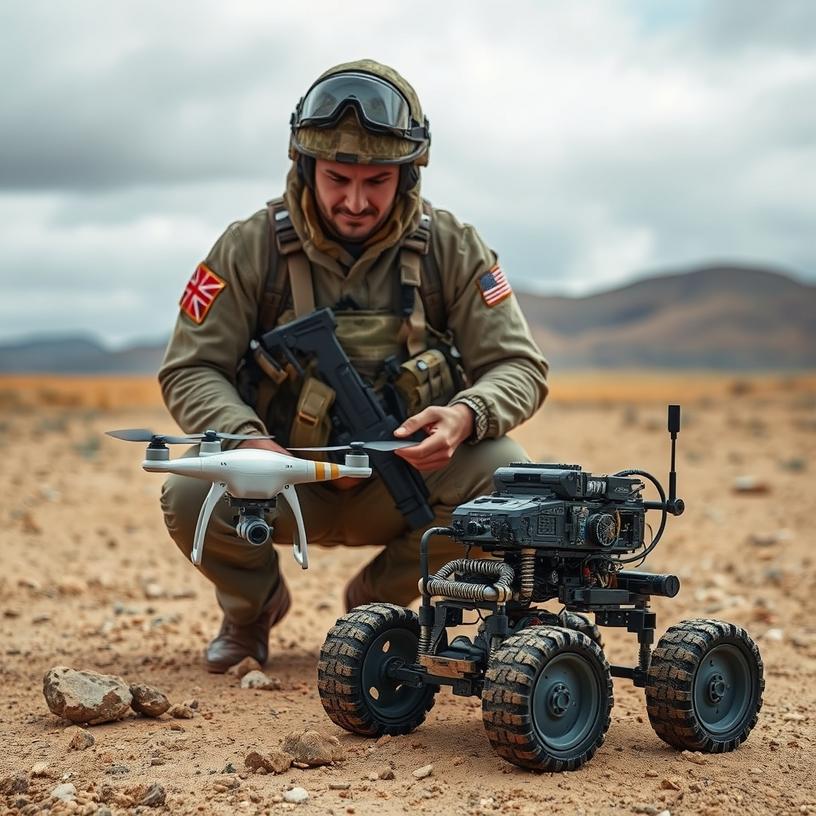
ToggleWhen you hear “drone” most people picture a buzzing camera in the sky, and when you hear “robot” you think of a metal box rolling over rocks. The British Army’s recent field trials proved that the reality is messier. Soldiers from the 3rd Infantry Brigade were sent to a remote training area with a mix of quad‑copter UAVs and four‑wheeled ground units. Their job was simple on paper: see how the machines could spot threats, carry supplies, and give a clearer picture of the battlefield. What they found was a list of everyday problems that no‑one talks about in glossy tech briefings. The experience reminded everyone that a piece of hardware is only as good as the context it works in, and that context is often unpredictable.
The exercise took place in a hilly, scrub‑covered zone that mimics the terrain of a modern conflict zone. Unlike a flat desert or a paved road, the ground was uneven, dotted with dry streams and occasional thickets. This setting forced the drones to navigate sudden altitude changes and the robots to cope with loose soil that could swallow wheels. Soldiers also introduced “real‑world” obstacles: improvised explosive device (IED) simulators, mock civilian structures, and even sudden weather shifts. By adding these variables, the army could see where the tech fell short before it ever saw combat. The result was a series of honest, sometimes frustrating, moments where a drone lost GPS lock behind a ridge or a robot got stuck in a soft patch of sand.
One of the biggest surprises was how quickly a small quadcopter could lose its advantage when the wind picked up. A gust of 20 km/h was enough to push the craft off its planned path, forcing the operator to constantly correct course. In dense foliage, the camera feed became jittery, and the drone’s ability to hover over a target for a clear shot vanished. Battery life also proved to be a hard ceiling; after about 25 minutes of continuous flight, the unit had to return for a swap, leaving a gap in coverage. Soldiers reported that they often preferred a quick visual check from a man‑ned observation post rather than waiting for a drone to recharge. These findings suggest that while aerial eyes are valuable, they still need a reliable backup plan.
The four‑wheeled robot, built to transport ammunition and small payloads, ran into trouble on the same terrain. Its suspension handled rocks well, but soft, loose soil turned the wheels into sinks. The robot’s autonomous navigation system struggled with the lack of clear visual markers, causing it to take wrong turns or stop altogether. When soldiers tried to manually override the system, the control latency was noticeable, making precise movements feel clunky. Another issue was noise; the motor whine was loud enough to give away its position, which could be a liability in a stealthy operation. The team also noted that the robot’s payload capacity, while impressive on paper, was limited by the need to keep weight low for mobility, reducing the amount of gear it could actually deliver.
What emerged from the trials was a clearer picture of how people and machines can complement each other. Soldiers found that they trusted their own eyes more than a flickering screen when the situation was fluid. However, the drones still offered a quick way to scout ahead, especially in open fields where line‑of‑sight was clear. The robots, despite their hiccups, proved useful for moving non‑critical supplies across safe zones, freeing soldiers to focus on the fight. The key takeaway was that technology should be treated as a tool, not a replacement. Training now includes scenarios where troops practice handing off tasks between a drone, a robot, and a human scout, building a rhythm that can adapt when one piece fails.
In the end, the British Army’s experiment reminded us that high‑tech gadgets are only part of the solution. They work best when paired with solid tactics, realistic training, and an honest assessment of their limits. Future designs will likely focus on longer battery life, better all‑terrain wheels, and smarter AI that can handle ambiguous environments without constant human input. Until then, soldiers will keep learning how to read a drone’s buzzing and a robot’s sputter as clues about the battlefield. The lesson is simple: technology can give you an edge, but only if you understand where that edge ends.
Source: Original Article



Comments are closed