

We are a digital agency helping businesses develop immersive, engaging, and user-focused web, app, and software solutions.
2310 Mira Vista Ave
Montrose, CA 91020

2500+ reviews based on client feedback
What's Included?
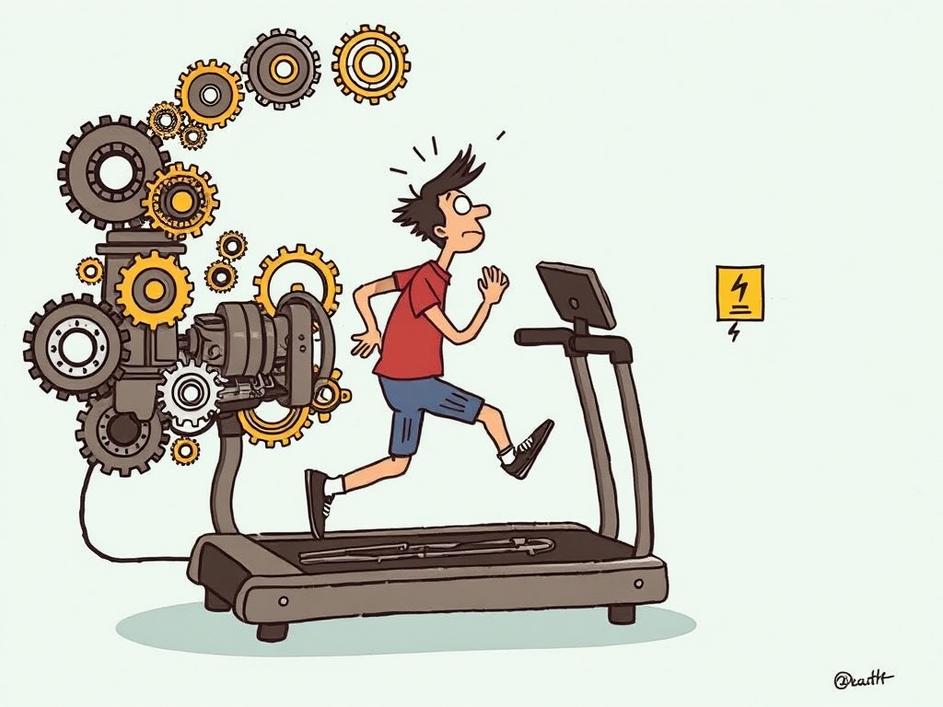
ToggleWe’re constantly bombarded with promises of increased productivity. New software, better workflows, and now, of course, artificial intelligence are all touted as the keys to getting more done in less time. But a strange thing is happening: despite all these advancements, the economy doesn’t seem to be reflecting a massive surge in output. It’s as if we’re running faster on a treadmill, but not actually getting anywhere quicker. Something is clearly amiss.
The core of the issue lies in the assumption that productivity scales linearly. The idea is simple: double your productivity, double your output. In reality, things are far more complex. Human endeavor, especially in creative or strategic fields, rarely works this way. Throwing more tools or AI at a problem doesn’t automatically translate into a proportional increase in results. There are diminishing returns, bottlenecks, and unforeseen consequences that quickly complicate the picture.
Focusing solely on individual efficiency overlooks the crucial role of collaboration and coordination. Even if each person on a team becomes twice as productive, the overall output may not double if communication breaks down or if there are dependencies between tasks. Imagine a relay race where each runner is faster, but the baton passes are fumbled. The team’s overall time suffers, regardless of individual speed improvements. Real-world work is far more like a relay race than a solo sprint.
Another critical factor is the human element itself. Our brains aren’t machines. We have limited attention spans, and we require periods of rest and reflection to perform at our best. Constantly chasing productivity gains can lead to burnout, reduced creativity, and ultimately, lower quality work. The obsession with squeezing every last drop of efficiency can ironically undermine the very productivity we’re trying to achieve. It’s like overwatering a plant – it might seem like a good idea, but it can ultimately be harmful.
AI tools are often presented as replacements for human effort, promising to automate away tedious tasks and free us up for more important work. And while AI can certainly be helpful in automating repetitive processes and speeding up certain workflows, it’s not a magic bullet. AI is best viewed as an amplifier, augmenting human capabilities rather than replacing them entirely. The real gains come from strategically integrating AI into existing workflows, not from blindly throwing AI at every problem and hoping for the best.
Over-reliance on AI can also stifle critical thinking. If we become too dependent on AI to generate ideas, analyze data, and make decisions, we risk losing our ability to think for ourselves. The ability to question assumptions, identify biases, and exercise independent judgment is crucial for innovation and problem-solving. If we outsource these cognitive functions to AI, we risk becoming passive consumers of information, rather than active creators and thinkers.
Perhaps the very definition of “work” is undergoing a transformation. In an age of automation, the most valuable skills may no longer be those that can be easily replicated by machines. Creativity, empathy, critical thinking, and complex problem-solving are becoming increasingly important. These are precisely the skills that are difficult to automate, and they represent the future of work. Focusing solely on metrics that measure easily quantifiable output may miss the bigger picture of how work is evolving.
To truly unlock the potential of increased productivity, we need to move beyond a narrow focus on individual efficiency and adopt a more holistic approach. This means considering the importance of collaboration, communication, and the human element. It also means recognizing the limitations of AI and using it strategically to augment human capabilities, rather than replace them entirely. We need to cultivate critical thinking skills, foster creativity, and prioritize well-being alongside productivity. Only then can we hope to create a truly sustainable and meaningful increase in output.
We also need to rethink how we measure productivity. Traditional metrics, such as hours worked or units produced, may not accurately capture the value of complex, knowledge-based work. We need to develop new metrics that account for creativity, innovation, and the overall impact of our work. This might involve focusing on qualitative measures, such as customer satisfaction, employee engagement, or the quality of solutions generated. By shifting our focus from quantity to quality, we can gain a more accurate understanding of true productivity.
The promise of AI-driven productivity gains is real, but it’s important to approach it with a healthy dose of skepticism and a clear understanding of the complexities involved. Simply doubling our efforts or throwing more technology at a problem won’t automatically lead to increased output. We need to cultivate critical thinking skills, prioritize collaboration, and recognize the importance of the human element. By taking a more holistic and balanced approach, we can unlock the true potential of AI and create a future where technology empowers us to do more meaningful work.



Comments are closed