

We are a digital agency helping businesses develop immersive, engaging, and user-focused web, app, and software solutions.
2310 Mira Vista Ave
Montrose, CA 91020

2500+ reviews based on client feedback
What's Included?
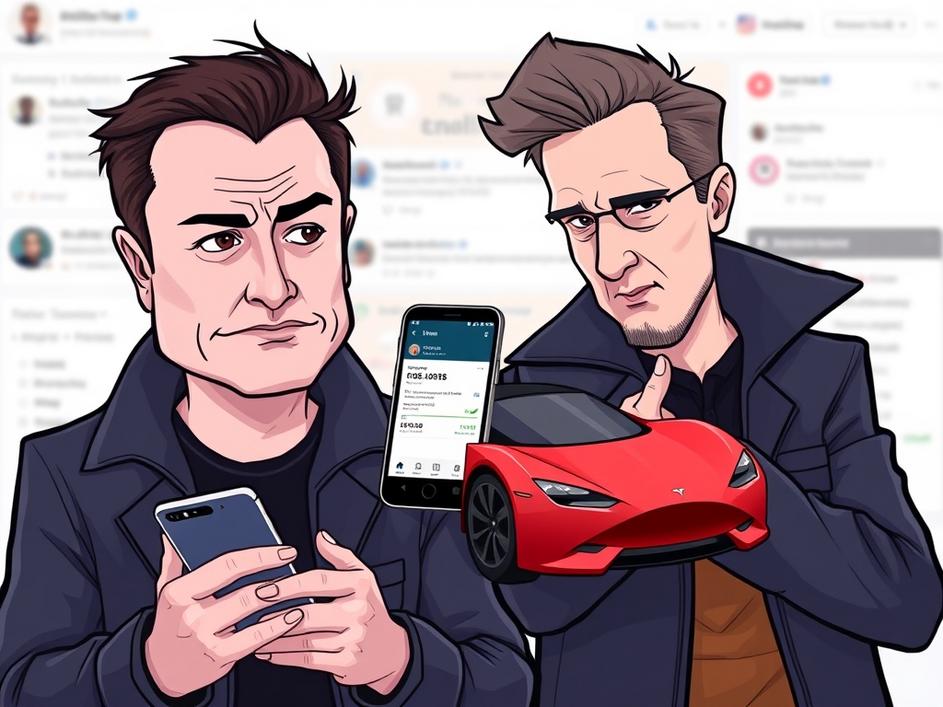
ToggleYou\’d think that when two of the most influential people in technology have a disagreement, it would be about the future of artificial intelligence, space colonization, or perhaps a new kind of internet. Instead, the latest public spat involved something much more… relatable: a car refund. Specifically, a Tesla Roadster. We\’re talking about Elon Musk, the driving force behind Tesla and SpaceX, and Sam Altman, the CEO of OpenAI. Their recent online exchange over a canceled car order and a requested refund really showed how even the smallest things can become big news when powerful figures are involved. It\’s a fascinating look at how these leaders interact with the public, with each other, and how social media amplifies everything.
It all started, as many modern dramas do, on social media. Sam Altman, known for his work in AI, decided to share some details about his experience trying to get a refund for a Tesla Roadster reservation. Now, this isn\’t just any car; the Roadster is Tesla\’s high-performance, long-delayed electric supercar. Altman posted publicly, showing screenshots that suggested he had requested a refund for his order. The implied message seemed to be that the process wasn\’t as smooth or quick as one might hope, especially for a loyal customer who had put down a significant amount of money years ago. His posts got a lot of attention, because when someone like Sam Altman shares a customer service complaint, it\’s bound to cause a stir. It put Tesla\’s refund process, and perhaps its communication, directly under the microscope of the tech world and beyond.
Of course, it wasn\’t long before Elon Musk, never one to shy away from an online debate, weighed in. And he didn\’t hold back. Musk quickly responded to Altman\’s public comments, stating that Altman had received his refund for the Roadster reservation “within 24 hours.” Musk\’s reaction wasn\’t just a simple factual correction; it carried a tone of criticism, implying that Altman\’s public complaint was unnecessary or misleading, given the swift resolution. This response from Musk added another layer to the story. It turned what might have been a simple customer service issue into a very public back-and-forth between two tech titans. It also highlighted Musk\’s tendency to personally address issues related to his companies, especially when he feels there\’s a misrepresentation.
So, why does a car refund become such a big deal? It\’s clearly not just about the money, which for either of these individuals is a drop in the ocean. This public exchange reveals several deeper currents. First, it\’s about public perception. Altman\’s initial posts could be seen as a way to gently nudge a company he\’s invested in, or perhaps to simply share a frustrating customer experience. Musk\’s response, on the other hand, was about defending his company\’s reputation and processes. He wanted to make it clear that Tesla handled the refund efficiently. In the high-stakes world of tech, where public image can sway investor confidence and customer loyalty, even minor incidents can turn into battles for narrative control. Everyone is watching, and every public statement is scrutinized.
Then there\’s the history between Musk and Altman. Musk was an early investor in OpenAI, but later became critical of its direction, even launching his own AI company, xAI, which he positions as a competitor. Given this existing tension, it\’s hard to view the Roadster refund drama in isolation. Was Altman\’s post a simple complaint, or a subtle jab? Was Musk\’s swift and critical reply just about the refund, or also about the broader competitive landscape? It\’s easy to speculate that these interactions are rarely just about the surface-level topic. There are often deeper, unspoken rivalries and disagreements at play, which can turn seemingly mundane issues into highly charged public spectacles. It also makes you wonder about the role of social media in such situations. Is it a transparent way to resolve issues, or simply a platform to air grievances and escalate personal battles?
What this whole episode really boils down to is how even the most powerful figures are now living out their lives, and their businesses, on a digital stage. Every tweet, every post, every interaction is visible, scrutinized, and often amplified beyond its original intent. For ordinary people, a delayed refund might mean a frustrating call to customer service. For Sam Altman, it means a public post that triggers a direct, equally public response from Elon Musk. This level of transparency, while sometimes refreshing, also blurs the lines between personal grievances and corporate communication. It means that the way these leaders handle seemingly small issues can say a lot about their leadership style, their patience, and even their company culture. It shows us that in today\’s world, customer service isn\’t just a back-office operation; it can be front-page news, especially when it involves people who shape our future.
Ultimately, the saga of Sam Altman\’s canceled Tesla Roadster reservation is a perfect illustration of our hyper-connected, social media-driven world. It wasn\’t just about a car; it was about reputation, public image, and the ongoing, often subtle, rivalries within the tech industry. It reminds us that even for billionaires, customer service can be a contentious topic, and that their interactions, no matter how trivial they seem, are always under the public eye. And so, what started as a simple refund request ended up being another chapter in the always-unfolding drama of Silicon Valley\’s most prominent personalities. It leaves us wondering what seemingly small issue will spark the next big public conversation among these titans of technology.


Comments are closed