

We are a digital agency helping businesses develop immersive, engaging, and user-focused web, app, and software solutions.
2310 Mira Vista Ave
Montrose, CA 91020

2500+ reviews based on client feedback
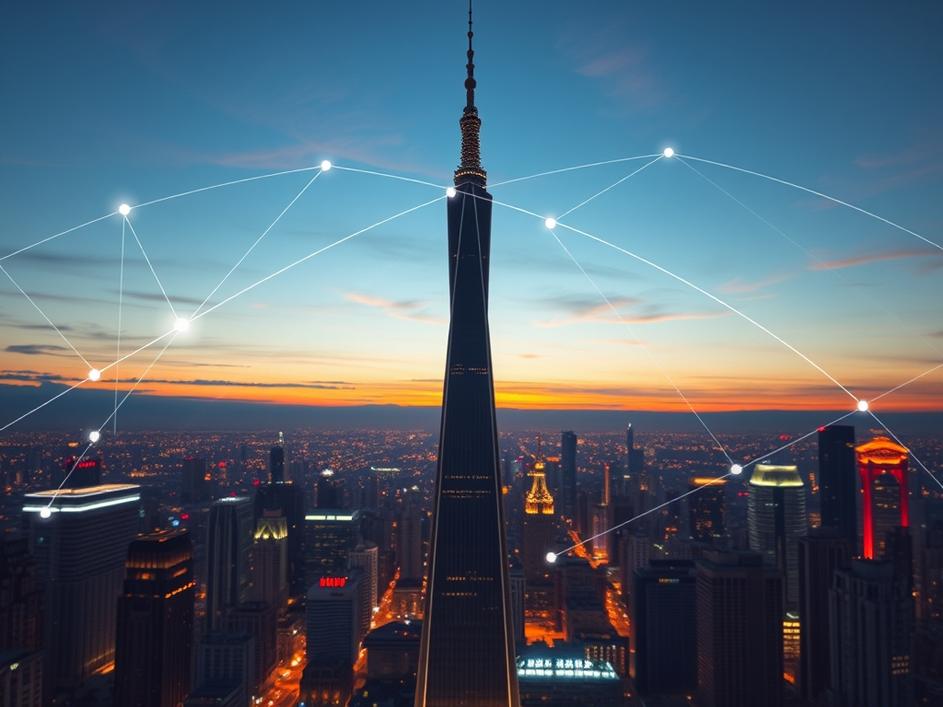
When you use your phone to stream a video, call a friend, or browse the internet, you\’re relying on a massive, unseen network of infrastructure. In China, a huge part of that network belongs to China Tower (SEHK:788). This company, which essentially provides the backbone for mobile communication, recently caught a lot of attention. Why? Because it just announced some pretty strong results for its first nine months of the year, showing higher sales and a healthy jump in net income. For anyone watching the market, this kind of performance naturally makes you wonder: what does it mean for the company’s value, and what\’s the big picture here? Let\’s take a closer look at this silent powerhouse and try to piece together its story.
\n\n
What's Included?
Toggle\n
So, what exactly does China Tower do? Think of them as the landlords of the wireless world. They own, operate, and maintain the vast majority of China\’s telecommunications towers and related infrastructure. This means they build and manage the physical sites where mobile carriers \– like China Mobile, China Unicom, and China Telecom \– place their antennas and other gear. Instead of each carrier building their own towers everywhere, they all share China Tower\’s facilities. This arrangement is super smart. It cuts down on costs for the mobile operators, reduces environmental impact by avoiding redundant structures, and allows for faster, more efficient network expansion across the country, even in remote areas. Without China Tower, the seamless mobile experience we often take for granted wouldn\’t be possible on the scale it is today.
\n\n
\n
The recent announcement about China Tower\’s nine-month performance really stands out. We\’re talking about solid increases in both sales and the money they actually get to keep, their net income. This isn’t just a small, lucky bump; it shows that their core business is doing very well. When a company like China Tower reports higher revenue, it usually means their clients \– the mobile carriers \– are expanding their networks, needing more space on towers, or adding more equipment. And when net income goes up, it means they\’re not just busy, but also managing their costs effectively and becoming more profitable. These figures are important because they give us a snapshot of the company\’s health and its ability to turn its operations into real financial gains. It tells us that demand for their services is robust and growing.
\n\n
\n
Why is China Tower seeing such good growth right now? A huge part of the answer lies in the ongoing rollout of 5G technology across China. 5G networks need a lot more antennas and a denser placement of equipment than older technologies. This means carriers need more spots on towers, and they need those towers to be closer together. China Tower is perfectly positioned to meet this demand. But it\’s not just 5G. People are also using more data than ever before, for everything from video calls to online gaming to smart home devices. This constant increase in data consumption pushes carriers to upgrade and expand their networks, directly benefiting China Tower. Plus, government initiatives often push for broader and deeper network coverage, especially in rural areas, further fueling the need for China Tower\’s infrastructure. It\’s a powerful mix of technology evolution and rising consumer needs.
\n\n
\n
When a company consistently posts strong results like China Tower has, it naturally impacts how people view its value. For a company that\’s essentially a utility-like service provider, stability and predictable growth are highly prized. Unlike a tech startup with huge, but sometimes volatile, swings, China Tower offers a steady stream of income based on long-term contracts with major telecom operators. This kind of reliable cash flow can make it a very attractive option for investors looking for stability rather than explosive, risky gains. Its essential role in a continually growing digital economy means it has a strong, defensible business model. When financial outlets like Simply Wall St review a company\’s valuation, they\’re not just looking at past numbers, but also trying to project future earnings based on these trends. For China Tower, the recent growth certainly adds a compelling layer to its ongoing value story, suggesting a robust underlying business with strong future prospects.
\n\n
\n
Even with strong performance, no company is without things to watch. For China Tower, some key factors include its heavy reliance on the three major Chinese mobile carriers. While these are huge, stable clients, it does mean a concentration of its customer base. Also, as a significant state-owned enterprise, government policies and directives can play a big role in its operations and future direction. Building and maintaining this vast network also requires continuous capital investment, which means a portion of its earnings will always go back into the business. While 5G is a huge driver now, the pace of future technological upgrades or changes in telecom strategy could also influence its long-term growth trajectory. It\’s always a balance between impressive current performance and understanding the unique dynamics of its operating environment.
\n\n
\n
China Tower\’s recent strong sales and profit growth aren\’t just isolated good news; they reflect a deeper trend: the foundational importance of its infrastructure in our increasingly connected world. As digital services expand and mobile data use continues its relentless climb, the need for robust, widespread network support will only grow. China Tower, by providing the physical scaffolding for this digital revolution, holds a truly essential position. While any investment requires a careful look at all angles, these latest numbers certainly highlight a company that\’s not just standing tall, but also growing stronger, quietly underpinning the daily digital lives of hundreds of millions.



Comments are closed