

We are a digital agency helping businesses develop immersive, engaging, and user-focused web, app, and software solutions.
2310 Mira Vista Ave
Montrose, CA 91020

2500+ reviews based on client feedback
What's Included?
ToggleWe’ve all been there. You’re working on your laptop, editing a document, looking up research, and checking emails all at once. Your single screen feels tiny. You switch back and forth, windows piling up, and suddenly, you’re lost in a sea of open tabs. We keep craving more screen space. Traditional laptops always limit how much visual real estate we can carry. Sure, you can hook up an external monitor at your desk, but what about when you’re on the go? Carrying a second, separate screen often seems like more hassle than it’s worth. We want flexibility and power, but also portability and simplicity. It’s a tough balance. For years, we’ve mostly just put up with these limits. So, when news pops up about a device that aims to blow those limits wide open, it’s hard not to pay attention. Something new is coming from a company called Phinge, and they’re calling their device “Textbook.” It promises to bring a whole new meaning to having enough screen space, wherever you are.
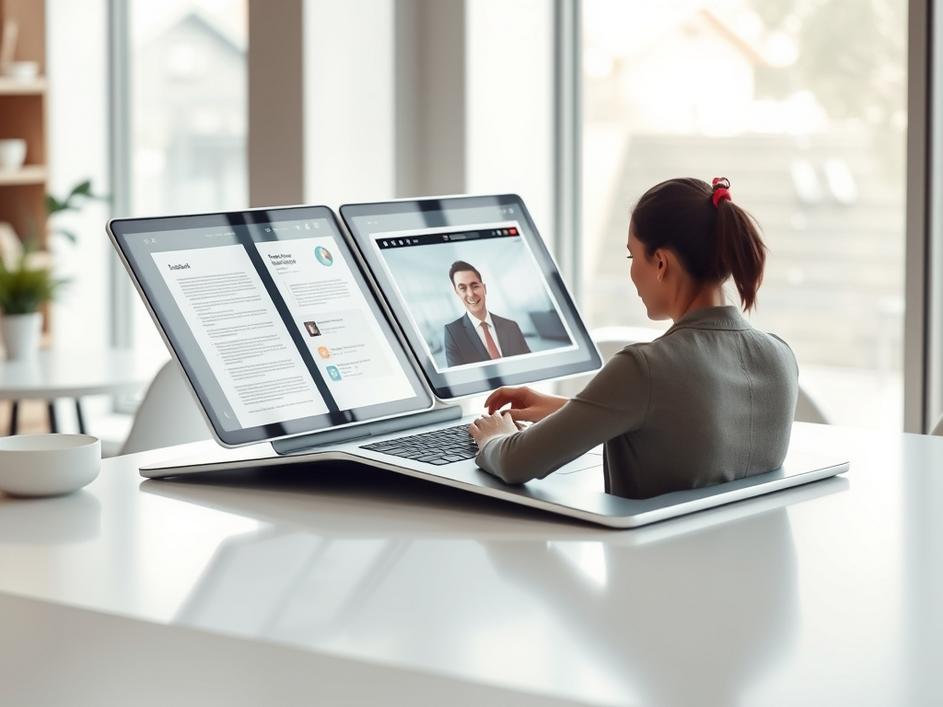
So, what exactly is this “Textbook” by Phinge? The big idea is to give you not just one, but multiple, and even triple, screens all built into one portable device. Think of it: a laptop that can unfold or expand to show you two or even three distinct displays. These aren’t just extra monitors you plug in; they’re integrated into the design. The news suggests these will be sleek, modern machines, launching in 2026. Picture this: your main laptop screen, then perhaps two more screens that slide out or fold open from the sides. And here’s where it gets even cooler – it’s designed to be wireless. This means you likely won’t be dealing with a tangle of cables just to get your full multi-screen setup going. It sounds like a truly all-in-one solution, blurring the lines between what a laptop is and what a tablet can be. The goal is clear: to give users a lot more room to work, play, or create, all within a single, elegant package. It’s about taking the idea of a desktop workstation and making it mobile, without the usual compromises.
At first, three screens might sound like overkill to some people. But think about how we actually use our computers today. Many of us already use two monitors at home or work because it makes a huge difference. Having a dedicated screen for your main task, another for reference, and maybe a third for communication apps, drastically improves how much you can get done. For creative pros, like graphic designers or video editors, more screen space means less scrolling and quicker access to tools. For students, it could mean having a textbook open on one screen, notes on another, and a research paper on the third. It’s not just about work either. Imagine watching a movie on one screen while browsing social media or gaming guides on another. Or even having a video call with friends on one part of your device while sharing something else on a different display. The “triple-screen” idea also suggests it might convert into several individual tablet-like devices, giving even more flexibility for sharing or different modes of use. This isn’t just about making things look fancy. It’s about making computing genuinely more efficient and versatile for how people live and work now. It’s about meeting a real need that has grown as our digital lives have become more complex.
The news also mentions that Textbook will be for use with something called “Netverse.” This is a fascinating detail because it suggests that Phinge isn’t just building cool new hardware; they might be building an entire ecosystem around it. What could “Netverse” be? It could be a custom operating system optimized for multiple screens, making it easy to manage windows and switch between tasks. Or maybe it’s a cloud-based platform that syncs your work across devices seamlessly, especially designed to take advantage of the Textbook’s unique multi-screen capabilities. It might even be a suite of productivity tools or applications that are specifically made to shine on a triple-screen setup, offering features that simply wouldn’t work as well on a single display. Think about how Apple has its own operating system and software that integrates tightly with its hardware, or how Google’s Chromebooks work with their cloud services. Phinge might be aiming for a similar level of integration, where the hardware and software work together in perfect harmony. This kind of deep integration is often what makes a product truly powerful and user-friendly, pushing it beyond just being a collection of impressive parts. It could mean a smoother, more intuitive experience, where your screens aren’t just there, but they feel like a natural extension of your workflow.
This concept of a triple-screen, laptop-tablet hybrid is exciting, but like any big leap in technology, it will face its questions. First, there’s the practical side. How heavy will this device be with all those screens and components? Will it truly be as portable as a standard laptop, or will it be chunky? Then there’s battery life. Running three screens simultaneously will demand a lot of power, so how long will it last on a charge? The price tag is another big one. Cutting-edge tech often comes with a premium, and Phinge will need to find a sweet spot that makes it appealing to many, not just early adopters. And what about durability? More moving parts and screens could mean more things to potentially break. However, if Phinge can nail these aspects, “Textbook” could truly change how we think about personal computing. It has the potential to redefine what productivity looks like, anywhere. It could make carrying multiple devices obsolete for many, simplifying our tech bags and our digital lives. The possibilities for creative work, detailed research, and immersive entertainment are huge.
Looking ahead to 2026, the arrival of Textbook by Phinge seems like a significant moment. For years, we’ve tweaked our existing laptops, added external monitors, and juggled multiple devices, all looking for more space and flexibility. This new device isn’t just adding another screen. It’s reimagining the entire personal computing experience from the ground up. It’s a bold step that suggests our future isn’t about smaller, simpler devices, but about smarter, more versatile ones that adapt to our complex needs. If Phinge can deliver on its promises of sleek design, seamless integration, and true portability for a multi-screen setup, then “Textbook” could be more than just a new gadget. It could be a window into a future where our digital workspaces are limitless, always with us, and always ready for whatever comes next. It’s a vision where the frustrating hunt for more screen real estate finally ends, giving way to a new era of effortless multitasking. Our digital lives just got a lot bigger, literally.



Comments are closed