

We are a digital agency helping businesses develop immersive, engaging, and user-focused web, app, and software solutions.
2310 Mira Vista Ave
Montrose, CA 91020

2500+ reviews based on client feedback
What's Included?
ToggleFor years, we’ve heard about how technology will make our lives easier, more productive, and ultimately, more fulfilling. The latest iteration of this promise comes in the form of Artificial Intelligence (AI). Ted Hanson, CEO of Everforth, recently discussed how AI could boost productivity and allow workers to focus on higher-value activities. It’s a compelling vision, but also one that requires a closer look. Are we really on the cusp of an AI-driven utopia, or are there potential pitfalls we need to consider?
Hanson’s point about focusing on “higher value” activities is intriguing. But what exactly does that mean in practice? For some, it might mean less time spent on tedious data entry and more time strategizing and problem-solving. For others, it could mean automating customer service inquiries to allow human agents to focus on complex customer issues. However, it raises questions about the skills workers will need in this new AI-powered landscape. Will everyone be equipped to handle these “higher value” tasks, or will further training and education be necessary?
The transition to an AI-driven workplace won’t be seamless. Many current roles involve tasks that are easily automated, and workers performing those tasks may find themselves displaced. The key to mitigating this lies in proactive retraining and upskilling initiatives. Companies need to invest in programs that equip their employees with the skills necessary to thrive in an AI-enhanced environment. This might involve learning data analysis, AI management, or focusing on uniquely human skills like creativity and critical thinking. Without adequate retraining, the promise of AI could turn into a reality of increased unemployment and economic inequality.
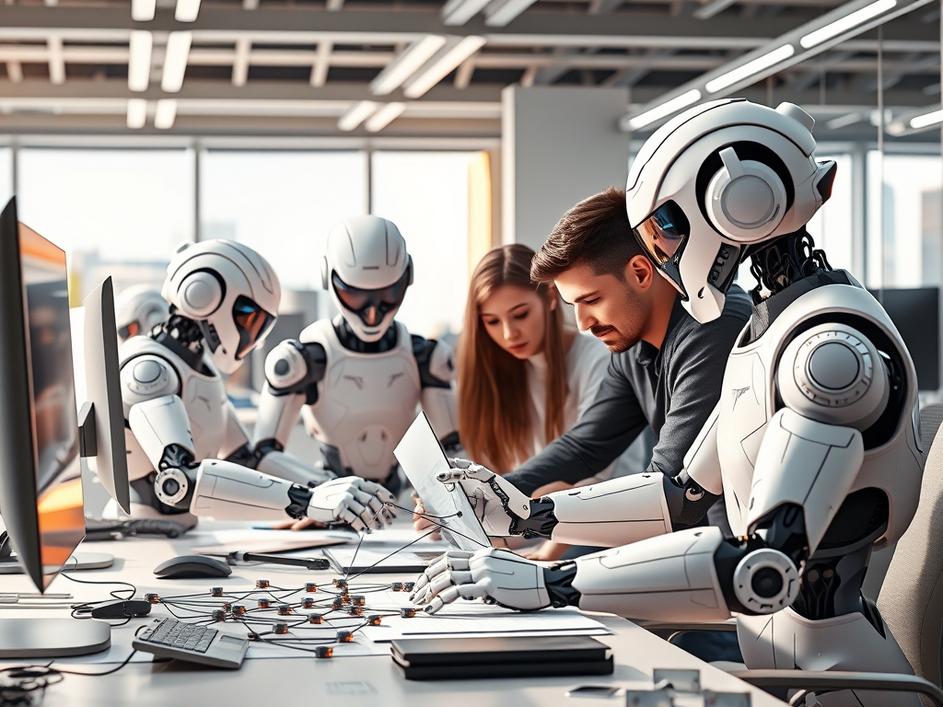
It’s important to remember that AI should be viewed as a tool to augment human capabilities, not replace them entirely. The most successful implementations of AI will likely be those that foster collaboration between humans and machines. AI can handle repetitive tasks, analyze vast amounts of data, and identify patterns that humans might miss. However, humans bring to the table creativity, emotional intelligence, and critical thinking – qualities that AI currently struggles to replicate. By combining the strengths of both, we can achieve outcomes that are far greater than either could achieve alone.
As AI becomes more pervasive, it’s crucial to address the ethical concerns that arise. Bias in AI algorithms is a significant problem. If the data used to train AI systems reflects existing societal biases, the AI will perpetuate and even amplify those biases. This can lead to unfair or discriminatory outcomes in areas like hiring, lending, and criminal justice. Therefore, it’s essential to develop strategies for identifying and mitigating bias in AI algorithms. Transparency and accountability are also crucial. We need to understand how AI systems make decisions and hold developers accountable for the consequences of their creations. This includes establishing clear guidelines for data privacy and security.
Ted Hanson’s vision of AI empowering workers to focus on higher-value tasks is a promising one. However, realizing this vision requires careful planning and execution. We need to invest in retraining and upskilling initiatives, foster collaboration between humans and machines, and address the ethical concerns that arise from AI. If we can do these things, AI has the potential to create a more productive, equitable, and fulfilling future of work. If we fail, we risk exacerbating existing inequalities and creating a society where only a select few benefit from the AI revolution. The path forward requires a cautious optimism, a willingness to embrace the potential of AI while also acknowledging and addressing its challenges.
The only constant is change, and the rapid advancement of AI underscores this point. Workers and businesses must be adaptable and willing to learn new skills and adopt new technologies. This requires a shift in mindset, from viewing learning as a one-time event to embracing it as a lifelong process. Those who are willing to adapt and learn will be best positioned to thrive in the AI-driven economy. Those who resist change risk being left behind.
The future of work is not predetermined. It is something we create through our choices and actions. We need to start having serious conversations about the role of AI in society and how we can ensure that it benefits everyone. This includes investing in education and training, promoting ethical AI development, and fostering collaboration between humans and machines. The time to act is now, before AI becomes even more deeply ingrained in our lives.
AI presents us with both challenges and opportunities. By addressing the ethical concerns, investing in retraining, and fostering collaboration, we can harness the power of AI to create a more productive, equitable, and fulfilling future of work. It won’t be easy, but the potential rewards are immense. It’s time to step up and shape the future we want to see.



Comments are closed