

We are a digital agency helping businesses develop immersive, engaging, and user-focused web, app, and software solutions.
2310 Mira Vista Ave
Montrose, CA 91020

2500+ reviews based on client feedback
What's Included?
ToggleElon Musk recently made some pretty big claims about the future. He thinks that in just 10 to 20 years, artificial intelligence and robotics will advance to the point where work becomes optional. Even more surprising, he believes money itself might become irrelevant. It’s a bold prediction, and one that’s got a lot of people talking. But is it actually realistic, or just wishful thinking from a tech visionary?
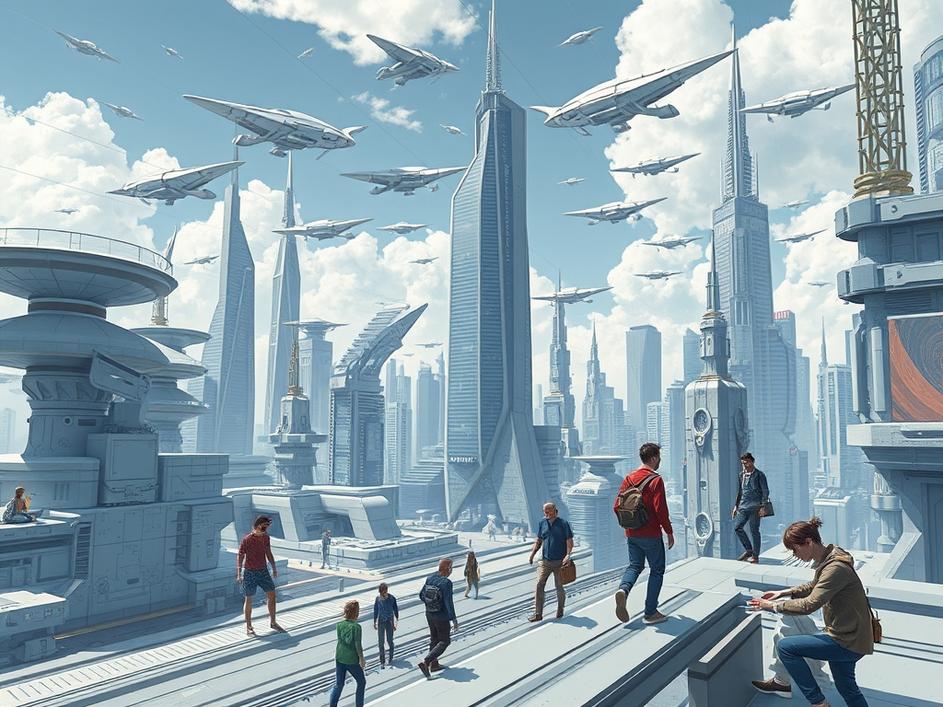
Musk’s argument hinges on the rapid progress we’re seeing in both AI and robotics. Think about it: self-driving cars are becoming more and more capable, AI is already writing code and creating art, and robots are performing increasingly complex tasks in factories. If these trends continue, it’s not hard to imagine a future where most jobs are automated. This raises a fundamental question: if machines can do everything, what will humans do?
Musk also suggests that money might become irrelevant. This is a trickier concept to grasp. Presumably, a world of abundance created by AI and robots would mean that basic needs are easily met. If everyone has access to food, shelter, and healthcare without needing to work, then the traditional incentive structure of money starts to break down. But what about desires beyond basic needs? What about luxury goods, travel, or creative pursuits? Would there still be a market for these things, and if so, how would they be distributed?
Even if technology makes work optional, it doesn’t necessarily mean people will stop wanting to contribute. Humans have an innate desire to be productive, to create, and to make a difference. In a post-work society, perhaps people would focus on pursuits that are personally meaningful, like art, science, community service, or simply learning new things. The challenge would be to create a society that supports these activities and provides a sense of purpose for everyone, regardless of their ability to “earn” a living.
Of course, there are plenty of potential problems with Musk’s vision. First, the transition to a post-work society could be incredibly disruptive. Millions of people could lose their jobs, leading to widespread unemployment and social unrest. Second, there’s the question of wealth distribution. Even if machines can produce abundance, who controls those machines and how is that abundance shared? A future where robots do all the work but a small elite controls all the wealth would be a dystopia, not a utopia. And third, we have to consider the psychological impact of not working. Work provides structure, purpose, and social connection for many people. Losing that could have serious consequences for mental health and well-being.
It’s important to approach Musk’s predictions with a healthy dose of skepticism. While technological progress is certainly accelerating, it’s impossible to know for sure what the future holds. It’s more likely that we’ll see a gradual shift in the nature of work, rather than a complete elimination of it. New jobs will likely emerge that require uniquely human skills, such as creativity, critical thinking, and emotional intelligence. And even if robots can do many things better than humans, there will always be a need for human oversight, maintenance, and ethical decision-making.
Regardless of whether Musk’s predictions come true, it’s important to start thinking about the future of work now. We need to invest in education and training programs that prepare people for the jobs of tomorrow. We need to explore alternative economic models, such as universal basic income, that could provide a safety net for those who are displaced by automation. And we need to have a serious conversation about the ethical implications of AI and robotics, to ensure that these technologies are used for the benefit of all humanity.
Musk’s vision of a post-work, post-scarcity future is certainly appealing. It’s a future where everyone is free to pursue their passions and live a life of meaning and purpose. But it’s also a future that requires careful planning, collaboration, and a willingness to address the potential challenges. Whether it becomes a reality depends not just on technological advancements, but also on our ability to create a just and equitable society. It’s a future worth striving for, but one that demands our careful attention and proactive engagement.


Comments are closed