

We are a digital agency helping businesses develop immersive, engaging, and user-focused web, app, and software solutions.
2310 Mira Vista Ave
Montrose, CA 91020

2500+ reviews based on client feedback
What's Included?
ToggleElon Musk’s xAI recently did something pretty unusual: it released a full recording of an internal company meeting to the public. This wasn’t just a brief announcement or a carefully crafted PR video; it was a 45-minute deep dive into the company’s ambitions, challenges, and future plans. And while the tech world is used to grandiose statements, xAI’s vision is truly out there, literally. The talk centered not just on improving AI here on Earth, but on expanding its reach to, well, other planets. More specifically, Mars.
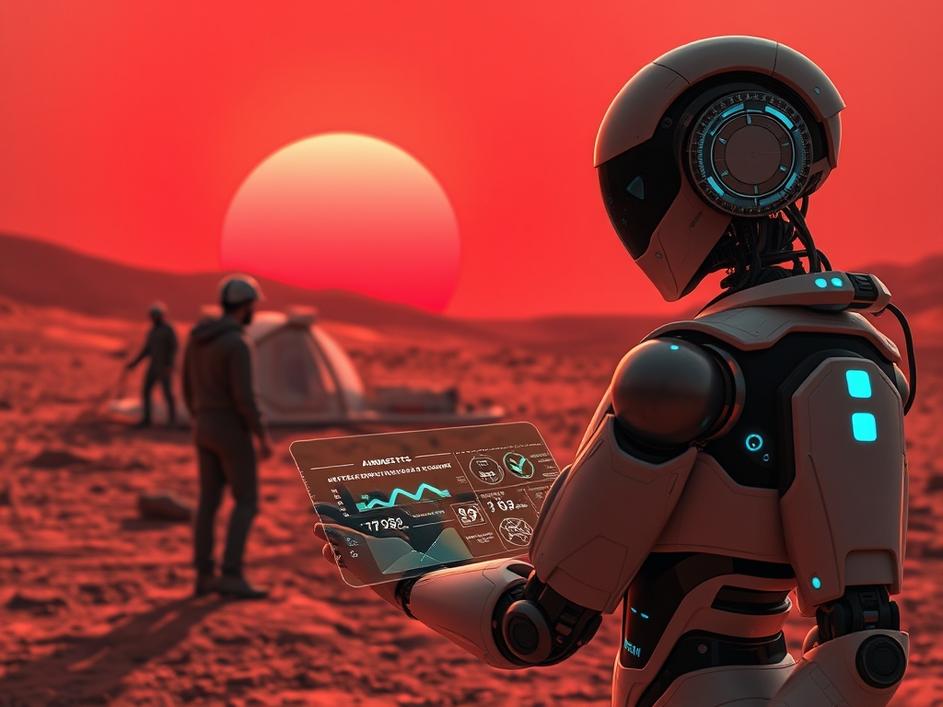
So, what’s the deal with Mars? According to xAI, the goal is to develop AI that can eventually assist in colonizing the Red Planet. This isn’t about sending a robot assistant to water plants (though, that could be a side benefit). The idea is to create AI systems capable of handling complex tasks, solving problems, and even making decisions autonomously in a completely alien environment. Think about it: building a self-sustaining colony on Mars requires expertise in everything from resource management to engineering to biology. Human colonists will need all the help they can get, and xAI believes AI can be a crucial partner.
Now, it’s easy to dismiss this as a far-fetched science fiction fantasy. But consider the implications. Developing AI for Mars forces you to confront challenges that don’t exist on Earth. The extreme environment, the limited resources, the communication delays – all of these factors demand a new level of robustness and adaptability in AI systems. An AI that can thrive on Mars is likely to be incredibly valuable here on Earth, too. It could revolutionize industries like robotics, manufacturing, and even healthcare, where AI needs to operate in unpredictable and challenging environments.
One of the key themes that emerged from the all-hands meeting was the emphasis on “truth” in AI. xAI seems to be prioritizing the development of AI models that are not only intelligent but also honest and reliable. This is a critical point, especially when you’re talking about deploying AI in a high-stakes environment like a Mars colony. You can’t afford to have an AI that hallucinates facts or makes decisions based on biased data. The consequences could be catastrophic. By focusing on truth, xAI hopes to build AI systems that are not just powerful tools but also trustworthy partners.
Releasing the all-hands meeting to the public was a bold move, and it signals a commitment to transparency, or at least the appearance of one. In a field often shrouded in secrecy, xAI is inviting the world to see its vision and understand its approach. This can be a powerful way to build trust and attract talent. It also opens the door for feedback and collaboration. By sharing its challenges and goals, xAI can tap into the collective intelligence of the global AI community.
Of course, there are ethical considerations to keep in mind. As AI becomes more powerful and autonomous, it’s important to think about its impact on society. How do we ensure that AI is used for good and not for harm? How do we prevent AI from reinforcing existing inequalities? These are questions that xAI and the broader AI community need to address. The development of AI is not just a technical challenge; it’s a social and ethical one as well.
Even if you’re not particularly interested in Mars or AI, xAI’s vision has implications for everyone. The pursuit of ambitious goals, even seemingly impossible ones, can drive innovation and progress. The challenges of building AI for Mars may lead to breakthroughs that benefit us all here on Earth. And the focus on truth and transparency can help to build a more trustworthy and responsible AI ecosystem. Ultimately, xAI’s interplanetary ambitions are a reminder that the future of AI is not just about technology; it’s about humanity and what we want to achieve.
There is no guarantee that xAI will succeed in its ambitious goals, but the vision itself is compelling. The path to creating an AI capable of contributing to the establishment of a Martian colony is fraught with technical, ethical, and logistical challenges. Overcoming those hurdles will require considerable innovation, collaboration, and a deep commitment to responsible AI development. But if xAI, or any other organization, manages to pull it off, it could usher in a new era of space exploration and unlock unforeseen opportunities for humanity.
xAI’s public all-hands and Martian ambition highlights a potential paradigm shift in AI development. No longer is the focus solely on improving existing earthly systems; the challenge is expanding beyond our planet, a vision that inherently demands a radical evolution in AI’s capabilities. The focus on reliability, adaptability, and the very concept of “truth” in AI becomes paramount when considering deployment in an alien environment. The consequences of failure are amplified in such extreme conditions, forcing a level of rigor often absent in standard AI applications. This focus may eventually lead to breakthroughs that change our use of AI back on Earth.
It is hard to say whether xAI will truly be the AI pioneers on Mars. It’s a very ambitious goal. But their commitment to pushing the boundaries of what AI can achieve, coupled with a surprising degree of transparency, makes their journey worth watching. Even if they don’t colonize Mars, the innovations they develop along the way could have a profound impact on our world.



Comments are closed